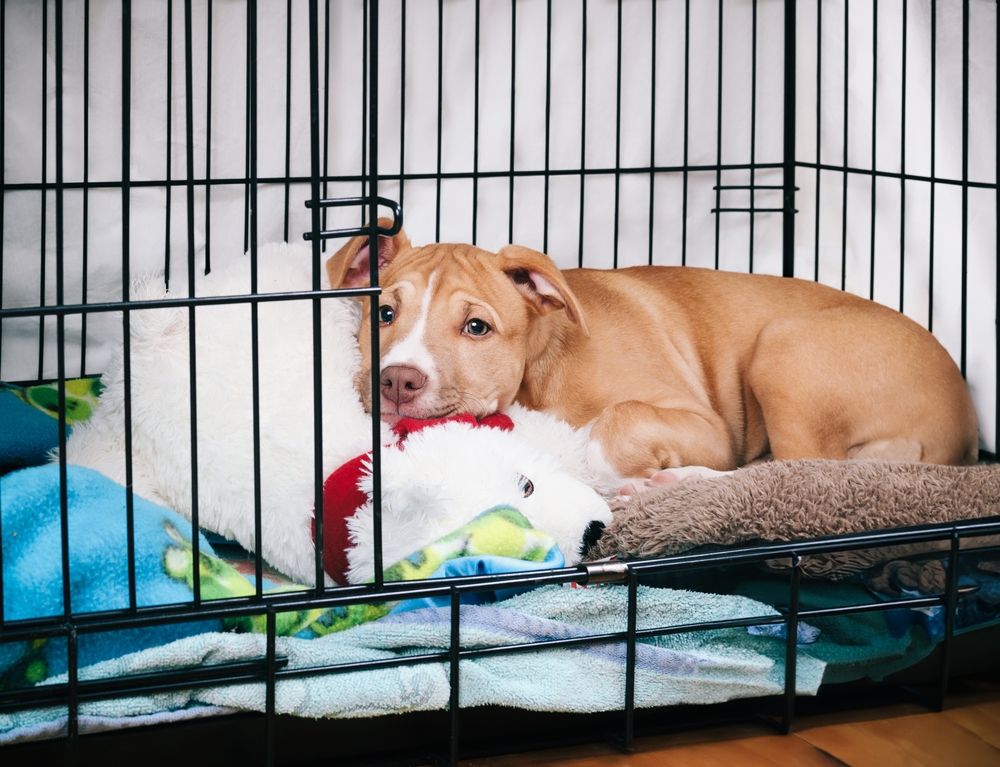
If your puppy is crying in the crate at night, you are not failing. You are simply living through the part of puppyhood nobody puts on the adoption photo.
Crying is a normal response to a huge life change: new home, new smells, new routine, and suddenly sleeping alone instead of in a warm puppy pile. The goal is not to “win” against crying. The goal is to teach your puppy that the crate is safe, predictable, and honestly… kind of boring. Boring is the dream.
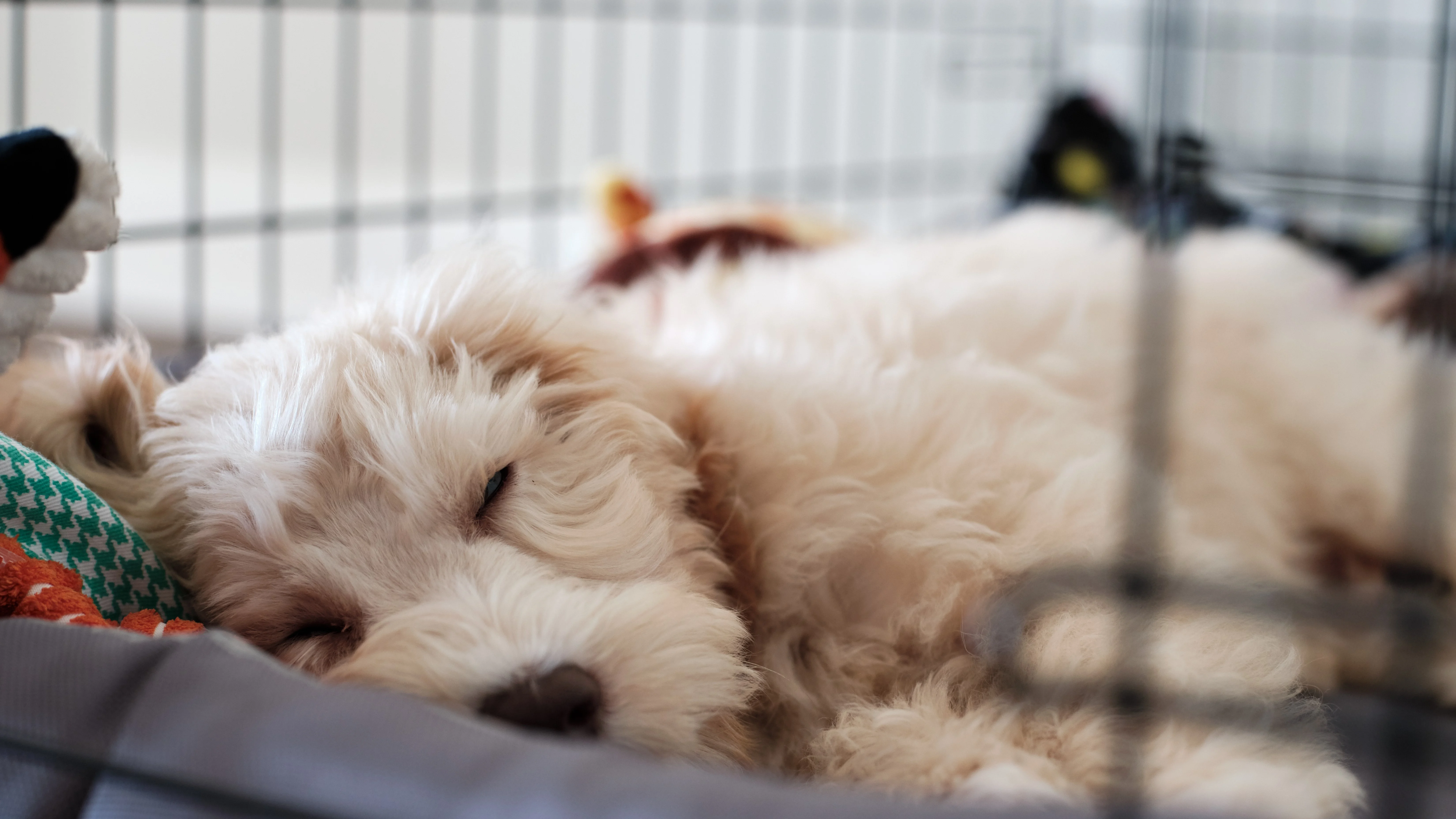
First, figure out what the crying means
Not all crate crying is the same. Your response should match the reason.
Common reasons puppies cry at night
- They need to potty. Puppies have tiny bladders, and nighttime potty breaks are normal for a while.
- They are lonely or startled. Sleeping alone is new, and some pups panic at the separation.
- They are overtired. A surprisingly large amount of nighttime screaming is an overtired toddler situation.
- They are uncomfortable. Too hot, too cold, bedding with tags or seams, crate in a draft, thirsty, or they cannot settle.
- They are under-exercised or under-stimulated. Not “run them into the ground,” but they do need age-appropriate activity and enrichment.
- They have learned that crying opens the crate. If the pattern is cry → door opens → freedom, your puppy is doing math.
- The crate setup is working against you. A too-large crate can feel less den-like for some puppies and it can also make it easier to potty in one corner, which then spirals into more distress.
Quick “is it a potty break?” checklist
If you are trying to decide whether to get up, ask yourself:
- Did they go potty right before bed?
- How long has it been since the last potty break?
- Are they sniffing, circling, or suddenly ramping up the urgency?
- Is your puppy very young (8 to 12 weeks) or newly home (first 3 to 5 nights)?
If you are unsure, assume potty at first. It is easier to prevent one accident than to rebuild crate confidence after your puppy sits in pee and panics.
When to worry
Most night whining is normal adjustment. But trust your gut and rule out health issues if anything feels off.
- Call your vet if crying comes with vomiting, diarrhea, a swollen belly, repeated straining, coughing, or sudden lethargy.
- Get help fast if the crying looks like panic: biting bars, throwing themselves at the door, drooling heavily, or rubbing their nose raw.
- Do not wait if your puppy suddenly starts crying at night after previously sleeping well. Sudden changes deserve a closer look.
Set up the crate for calmer sleep
Before you troubleshoot training, fix the environment. A better setup can make a noticeable difference in how quickly many puppies settle.
Crate location: start close, then earn distance
In most homes, the fastest path to quiet is putting the crate near your bed for the first week or two. You can gradually move it farther away once your puppy sleeps calmly.
If your puppy can see you, smell you, and hear you breathing, they often settle faster. This is not “spoiling.” This is smart acclimation.
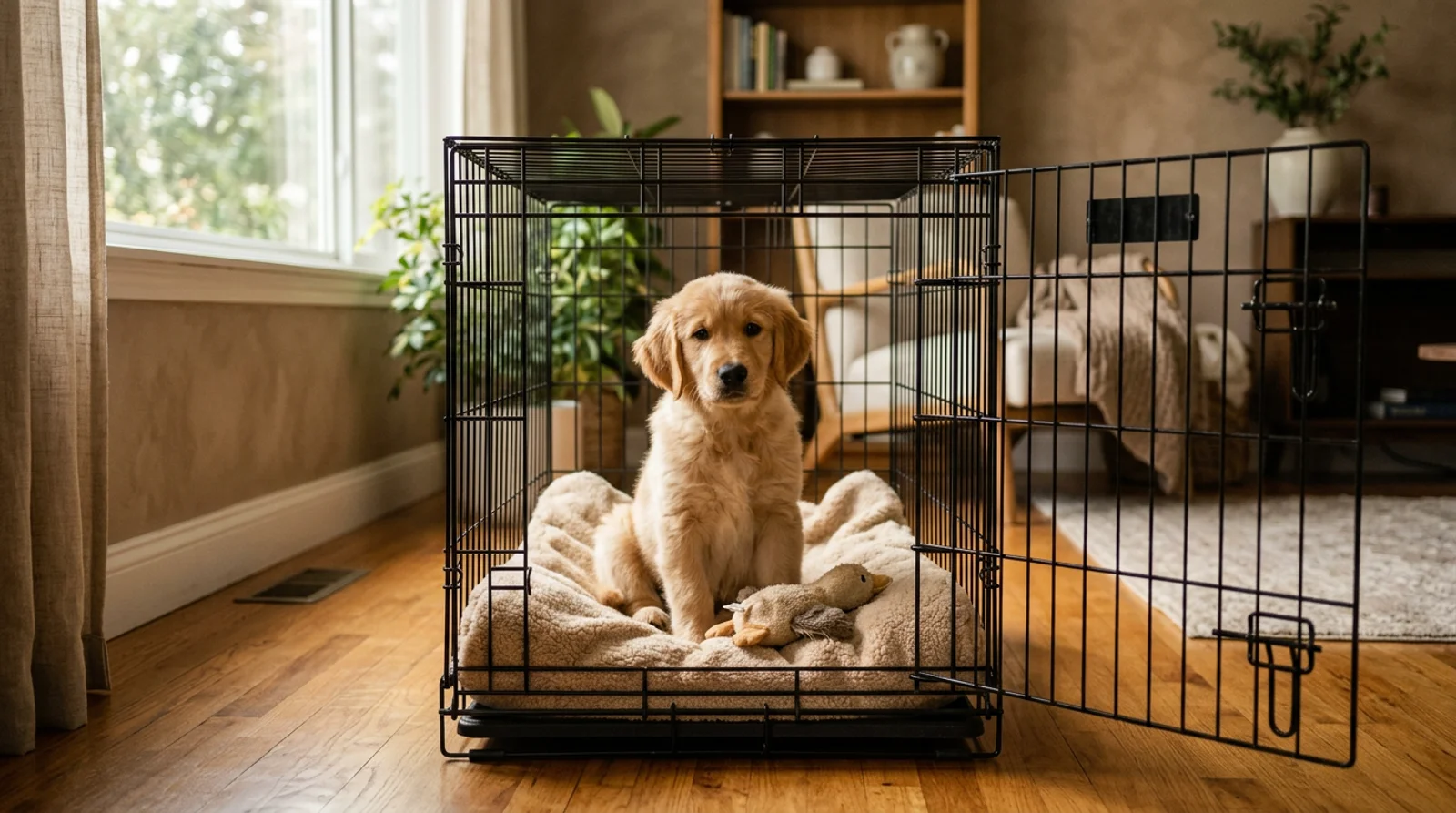
Make the crate feel like a den
- Cover 2 to 3 sides with a breathable crate cover or blanket so it feels less exposed. Leave airflow on at least one side.
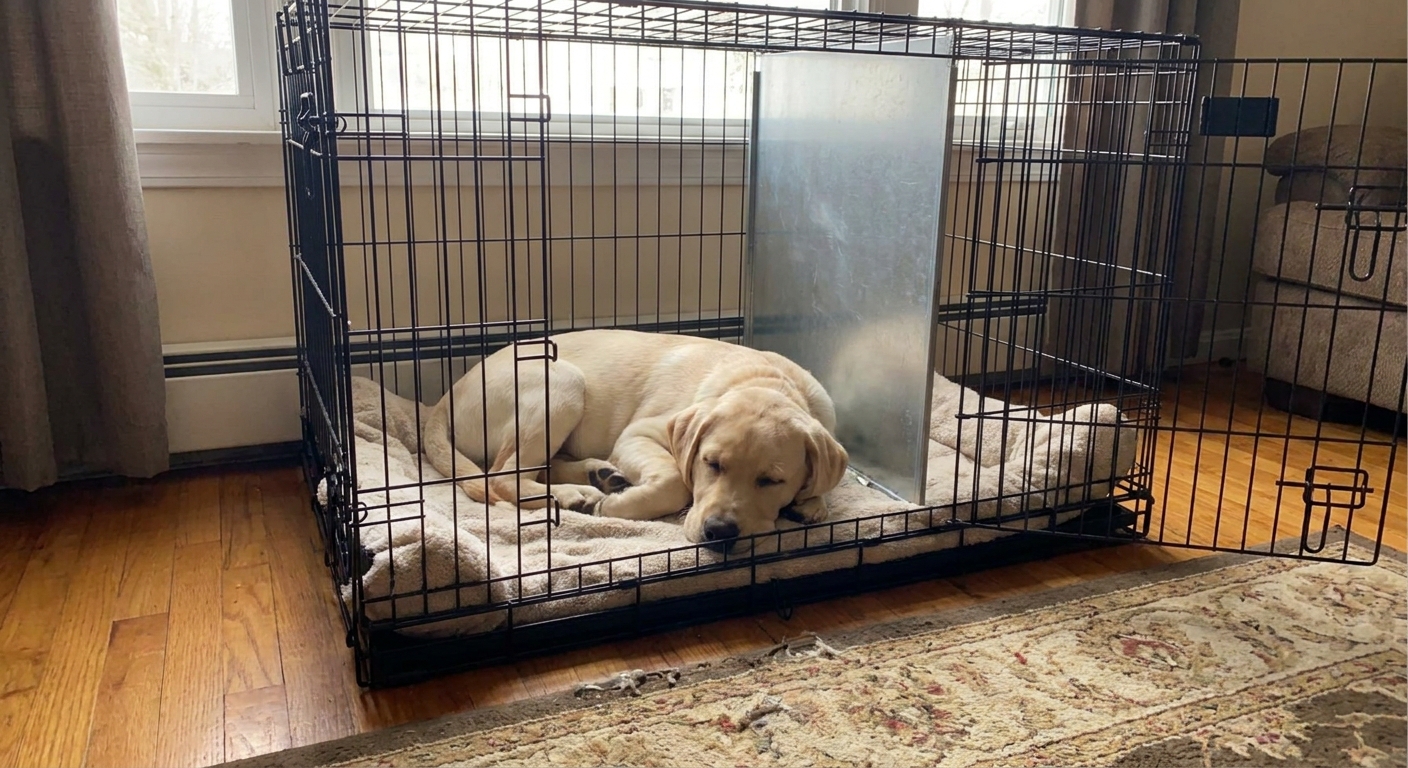
- Right-sized space. Your puppy should be able to stand up, turn around, and lie down comfortably, but not have a huge apartment. If you have a large crate, use a divider panel.
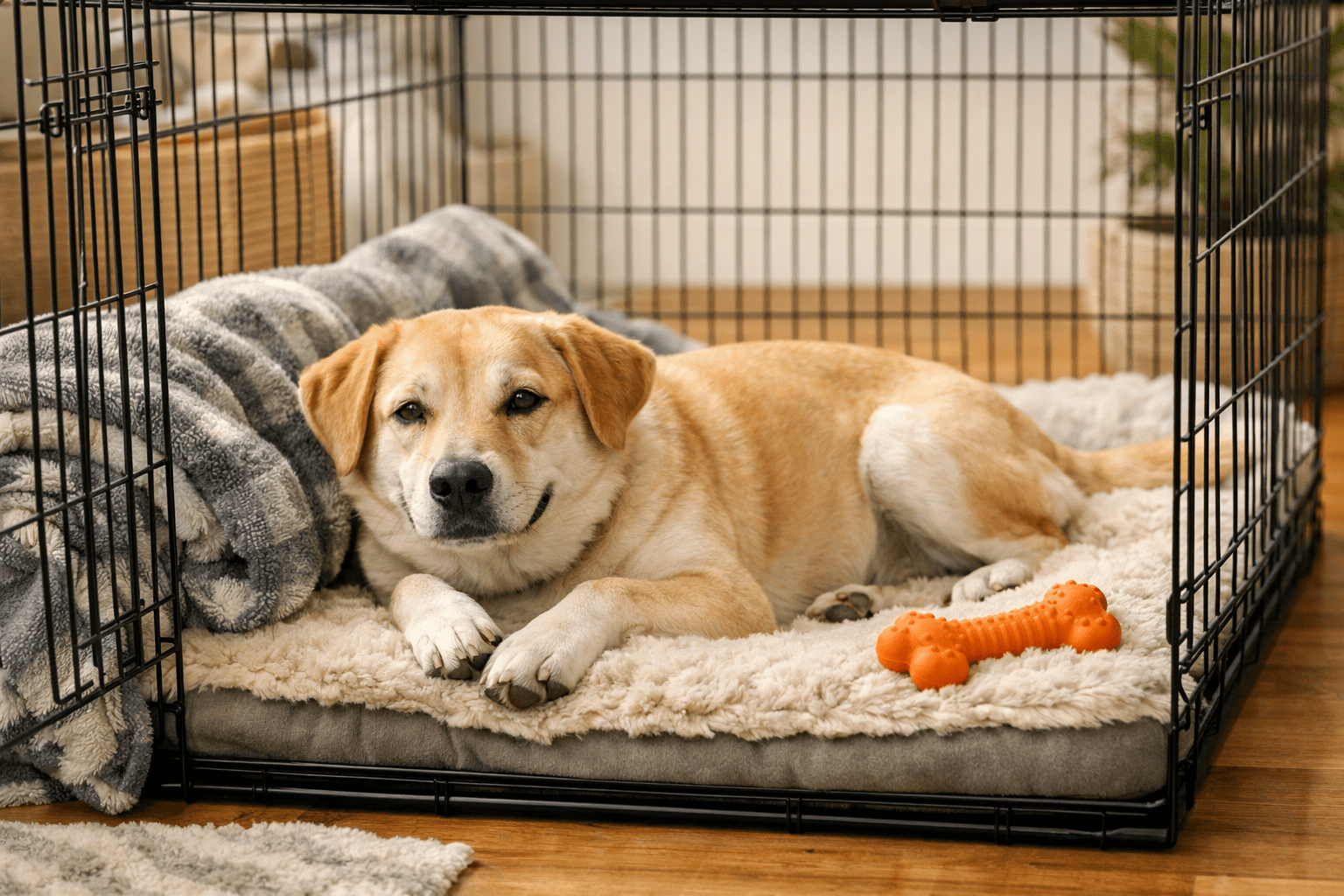
- Comfort, safely. A flat mat or crate pad works for many puppies. If your pup chews bedding, go simpler until chewing improves.
Add a calming cue, not a party
A gentle, consistent cue can help: a fan for white noise, soft classical music, or a steady sound machine. Keep it the same every night.
Skip anything that gets your puppy amped up, like exciting toys that squeak or bounce around in the crate.
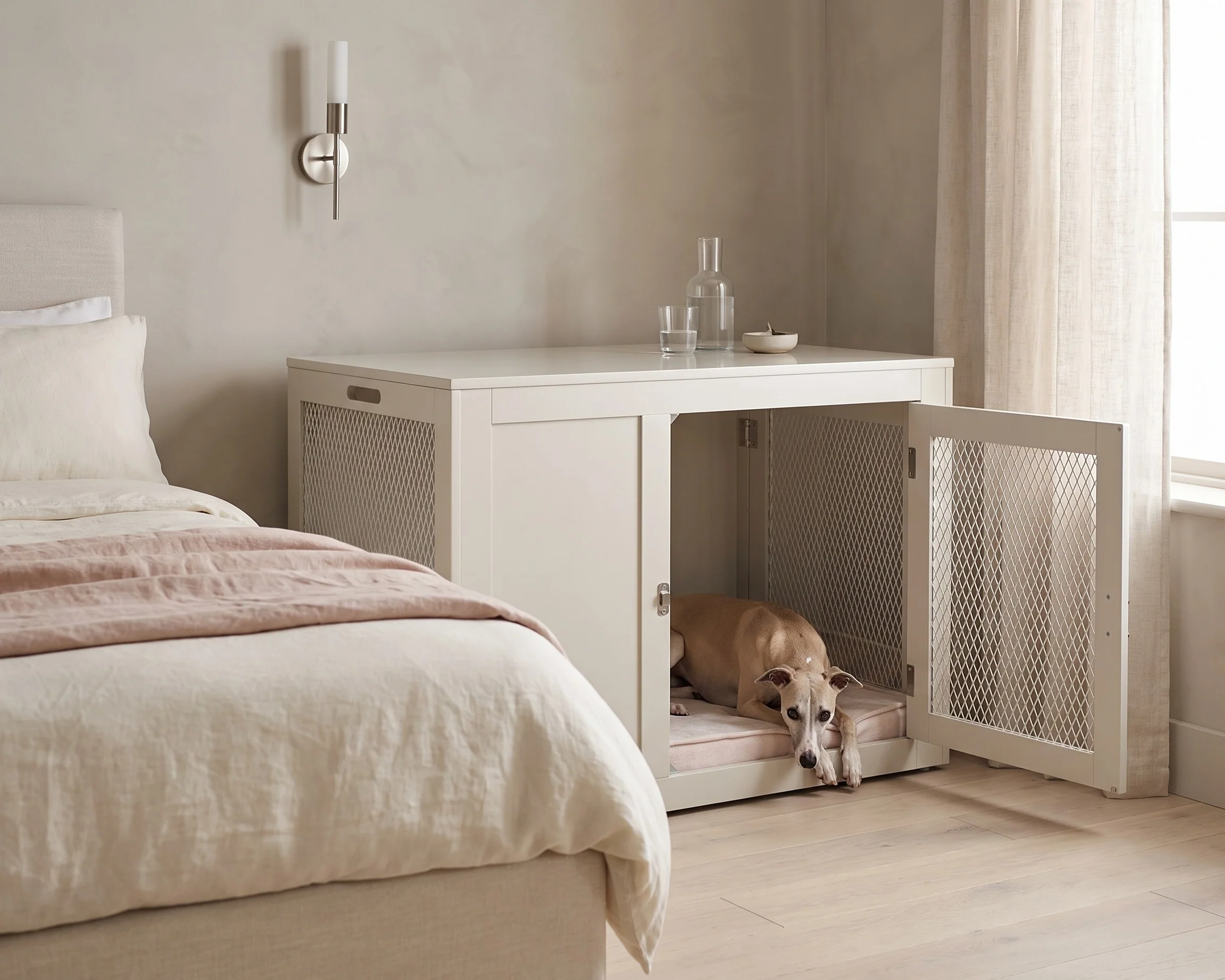
The bedtime routine that prevents crate crying
Puppies settle best when bedtime is predictable. Here is the routine I use with many foster pups because it is simple and repeatable.
60 minutes before bed
- Last “big” potty break. Give them time to fully empty out, not a rushed 10-second trip.
- Calm play or a short training session. A few sits, name game, and gentle tug can take the edge off without hyping them up.
- Wind-down time. Dim lights, quieter voices, fewer exciting interactions.
15 minutes before bed
- Offer a small, safe crate activity. Many puppies settle nicely with licking. A frozen, puppy-safe rubber food toy (Kong-style) sized appropriately is usually a safer bet than a loose chew. Avoid rawhide, bully sticks, cooked bones, or anything your puppy can break into chunks. If your puppy is a power chewer or shreds toys, skip overnight items and keep the crate simple.
- Be careful with water rules. Some people pick up the water bowl 1 to 2 hours before bed to reduce potty alarms, but it is not right for every puppy. Do not restrict water for very young puppies, in hot rooms, after heavy play, or if your puppy has any medical concern. When in doubt, ask your veterinarian and focus on more frequent potty breaks instead of less water.
Right before the crate door closes
- Final potty break. Calm, boring, on-leash, no play.
- Into the crate with a treat. Treat goes in, puppy goes in, door closes gently. No dramatic goodbyes.
- Same phrase every night. Something like “Bedtime” or “Good night.” Consistency matters more than the words.
What to do when your puppy cries
This is the moment that makes people feel stuck. You want to comfort them, but you do not want to teach them that screaming is the key that unlocks the door.
Step 1: Pause for 30 to 90 seconds
Some puppies do a short “protest cry” and then settle. Give them a chance to figure it out, especially if you know they pottied recently.
Step 2: Offer calm reassurance without opening the door
- Speak softly: “Shhh, you’re okay.”
- Place your fingers near the crate for a sniff.
- If the crate is next to your bed, let your puppy hear you breathing and staying put.
Keep your energy low. You are a boring lighthouse, not a cruise ship.
Step 3: If you suspect potty, take a boring potty break
If the crying escalates or it has been long enough that a potty break is likely, do this:
- Open the crate calmly. No praise party.
- Carry or leash your puppy straight to the potty spot.
- Minimal talking. No play. No wandering around the house.
- If they potty, quiet praise and straight back to the crate.
- If they do not potty within 3 to 5 minutes, back to the crate anyway.
This teaches an important rule: nighttime wake-ups are for potty, not for fun.
Step 4: Avoid “accidental rewards”
Try not to do these during crying:
- Do not immediately open the crate the second the crying starts (unless it is a clear potty emergency).
- Do not bring them into bed as a default fix if your long-term plan is crate sleeping. You can choose co-sleeping, but decide on purpose, not because a tiny siren wore you down at 2:13 AM.
- Do not scold, bang the crate, or use spray bottles. Fear makes crate training harder, not faster.
Daytime training that fixes nighttime crying
Night crying is usually a symptom of a crate relationship that is still too new. The best way to improve nights is to make the crate feel wonderful during the day.
Crate game #1: Treats in the crate
Several times a day, toss a treat into the crate and let your puppy go in and eat it. Door stays open. Walk away. Repeat.
Crate game #2: Meals in the crate
Feed meals in the crate with the door open at first. Over days, close the door while they eat, then open it before they finish, so the door opening does not become the “big moment.”
Crate game #3: Short naps with you nearby
When your puppy is already sleepy, guide them into the crate and sit nearby for 5 to 10 minutes. Gradually increase distance and time.
Build alone time gently
A common trap is only using the crate when you leave or at night. That makes the crate feel like “the place where I get abandoned.” Instead:
- Crate for 3 minutes while you fold laundry.
- Crate for 5 minutes while you shower.
- Crate for 10 minutes while you eat dinner.
Small reps add up fast.
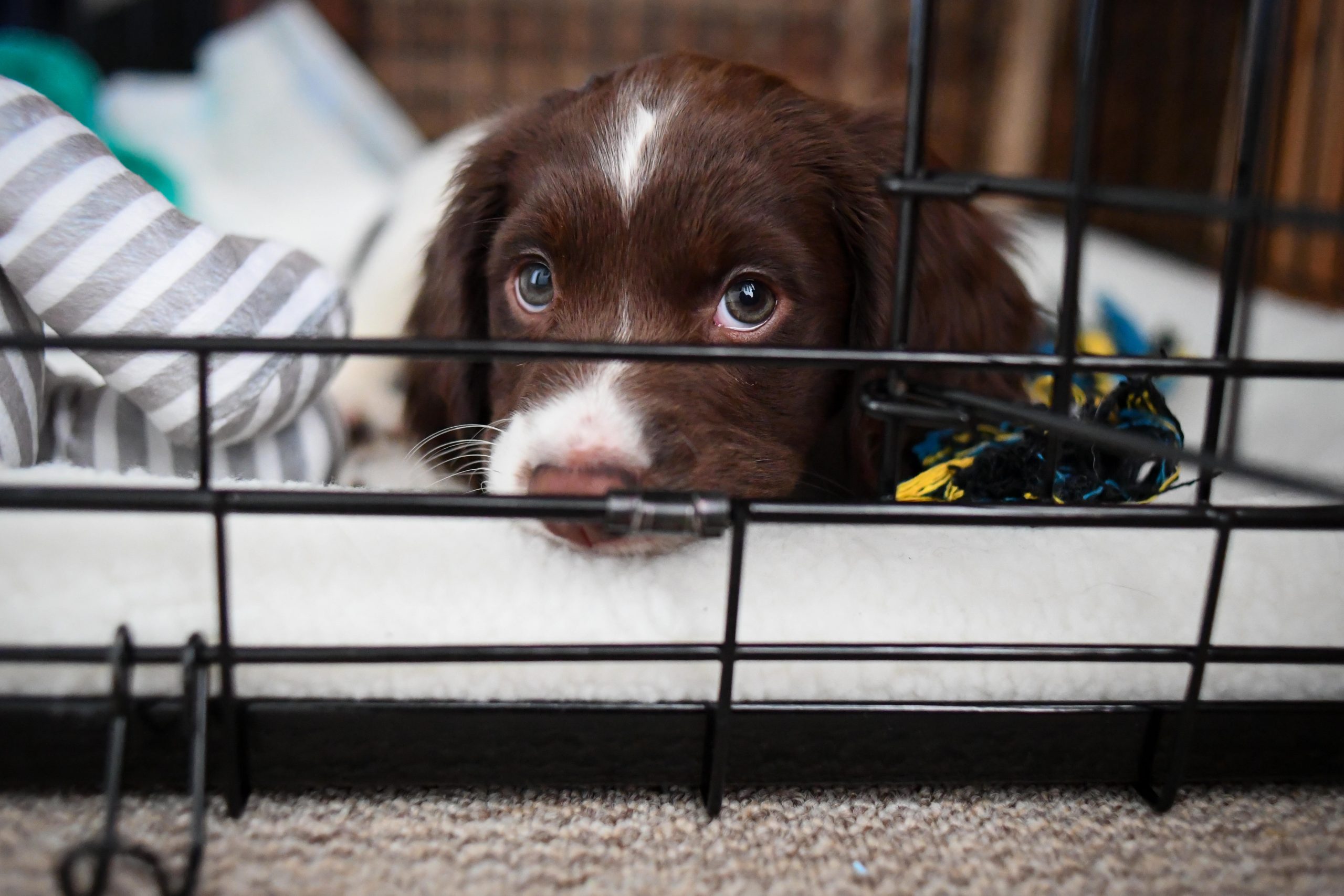
Troubleshooting by situation
If your puppy screams when the door closes
- Go back a step. Practice door movement without fully closing it.
- Close the door for 1 second, treat, open. Repeat.
- Gradually build: 3 seconds, 10 seconds, 30 seconds.
You are teaching: door closes, good things happen, door opens calmly.
If your puppy settles, then wakes up crying an hour later
- Likely potty or a light sleeper who got spooked.
- Check room temperature and noise.
- Try white noise and a more den-like cover (with airflow).
- Consider moving the crate closer to you temporarily.
If crying is worse after a big, busy day
Overstimulation can backfire. Puppies need rest to process new experiences. Add a calm decompression routine before bed and keep evenings quieter.
If your puppy is chewing the crate or hurting themselves
This is not the time to “let them cry it out.” If your puppy is biting bars, rubbing their nose raw, or panicking, pause and reassess:
- Talk to your veterinarian to rule out pain or medical issues.
- Consult a qualified trainer who uses reward-based methods.
- Use an exercise pen setup or a puppy-proofed small room temporarily if the crate is triggering panic.
If you suspect separation anxiety, not normal adjustment
Normal puppy adjustment usually improves with steady routines and daytime crate games. Separation distress often looks bigger: intense panic, heavy drooling, nonstop screaming, or escalating behavior that does not improve over time. If that is what you are seeing, get professional help early. A reward-based trainer or a veterinary behaviorist can save you weeks of misery and keep your puppy from rehearsing panic.
How long does crate crying last?
With a good setup and consistent routine, many puppies improve a lot within about 3 to 14 nights. Some take longer, especially if they are very young, have a different history with confinement, or are struggling with separation distress.
Very young puppies may still need nighttime potty breaks for a few weeks. A common rule of thumb is that a puppy can hold it for about age in months + 1 hour, but individuals vary. Treat it as a starting point, not a promise.
Progress often looks like this:
- Night 1 to 3: lots of protest, frequent wake-ups
- Night 4 to 7: shorter crying bursts, easier settling
- Week 2: longer sleep stretches, fewer wake-ups
If you are not seeing any improvement after two weeks of consistent work, or the crying seems panicked, get help early. There is no prize for suffering.
Crate time basics
The crate is a helpful tool, not a storage unit. Try not to ask your puppy to do a full night in the crate and then a full workday too. Young puppies need frequent potty breaks, movement, and social time to develop normally. If your schedule is tight, consider a midday dog walker, a trusted friend, or an exercise pen and potty area setup so your puppy is not forced to choose between holding it too long or soiling their space.
Common mistakes
- Too much freedom too soon. A giant crate without a divider can encourage pottying in one corner, and some puppies also settle better in a smaller, den-like space.
- Using the crate only for bedtime. Daytime positive reps matter.
- Accidentally throwing a midnight party. Talking, cuddling, wandering the house, or play during potty breaks trains wake-ups.
- Inconsistent rules. If sometimes crying works and sometimes it does not, puppies will cry longer because they have learned it might pay off.
- Overdoing exercise late at night. A wired puppy is not a tired puppy.
FAQ
Should I ignore my puppy crying in the crate at night?
Ignore brief protest whining if you are confident they do not need to potty and they are safe. Do not ignore panic or signs they may need the bathroom. When in doubt early on, do a quick, boring potty trip.
Is it okay to put a blanket over the crate?
Often, yes. Covering 2 to 3 sides can help many puppies relax. Make sure airflow is good, the puppy cannot pull the fabric inside to chew it, and the room temperature is safe.
What if my puppy only stops crying when I sit right next to the crate?
Start there. Then fade your presence gradually: sit next to the crate for a few nights, then sit a few feet away, then move to your bed, then move the crate slightly farther away over time. Slow and steady beats restarting from scratch.
Can I use a heartbeat toy?
Some puppies love them, some do not care. If you use one, supervise at first to make sure your puppy is not shredding it and swallowing pieces. It is a tool, not a requirement.
My puppy cries even after a potty break. Now what?
Go back to calm reassurance and let them settle. Keep the environment quiet and boring. If this repeats, work on daytime crate training and consider moving the crate closer to your bed temporarily.
A simple 7-night plan
Nights 1 to 2: Safety first
- Crate next to your bed
- Cover 2 sides, add steady white noise
- Set an alarm for one scheduled potty break if your puppy is very young
Nights 3 to 4: Fade your help
- Wait 30 to 90 seconds before responding to whining
- Use quiet voice reassurance instead of opening the door
- Keep potty breaks boring and quick
Nights 5 to 7: Build independence
- Increase daytime crate naps
- Practice short closed-door crate sessions while you are home
- If your puppy is settling quickly, move the crate a small distance away (a foot or two at a time)
If you are consistent, many puppies start sleeping longer stretches by the end of the first week. And if you are in the thick of it right now, I promise: you will sleep again.