Separation anxiety can look dramatic, but it usually starts in a very ordinary way: your puppy follows you everywhere, you leave once, they panic, and then they learn that being alone feels scary. The good news is you can prevent a lot of that spiral with a handful of small, boring routines. Boring is the goal. Boring is peace.
Below are the same exercises I use with foster puppies, including the clingy velcro ones who would absolutely crawl into my hoodie if they could. We are not aiming for a puppy who “doesn’t care” about you. We are aiming for a puppy who trusts you will come back.
First, know what you are preventing
Puppies protest when you leave for a few different reasons. The plan changes a little depending on what you are seeing.
- Normal puppy fussing: mild whining for a minute, then settling. This is common, especially in the first few weeks.
- FOMO and over-attachment: barking or whining because they want to be with you, but they can still eat, play, and settle eventually.
- True separation distress: panicked vocalizing, drooling, trying to escape a crate, hurting themselves, refusing food, frantic pacing, or destructive behavior focused on doors and windows.
If you suspect true separation distress, start with the steps below, but go more slowly than you think you need to. Also know this: prevention is simpler than treatment. If your puppy is already in full panic when alone, you may need a structured, step-by-step protocol and, in some cases, help from your vet and a qualified trainer who specializes in separation-related behavior. Some dogs also benefit from medication support under veterinary guidance, especially if panic is intense or long-standing.
The foundation: independence while you are still home
Most people practice “alone time” only when they actually have to leave. That is like trying to learn swimming by jumping into the deep end carrying groceries. Instead, we teach your puppy this simple truth: you can be nearby and unavailable, and everything is still fine.
Exercise 1: The “I exist, you chill” settle
Do this several times a day, even for 1 to 3 minutes.
- Give your puppy a safe chew or stuffed food toy on a bed, mat, or in an open crate.
- Sit down nearby and do something boring. Scroll, fold laundry, read.
- If your puppy gets up to climb you, calmly guide them back to their spot and help them re-engage with the chew.
- When they settle, stay neutral. Quiet is the reward.
This is how puppies learn to self-regulate. Not by being entertained 24/7, but by practicing calm.
Exercise 2: Baby gates and micro-separations
Before your puppy can handle you leaving the house, they need to handle you being behind a barrier.
- Use a baby gate, playpen, or x-pen.
- Step to the other side for 2 seconds, then return.
- Repeat, slowly increasing to 5 seconds, 10 seconds, 20 seconds.
- Do it randomly throughout the day so it is not a big, scary event.
Important: return when your puppy is quiet if possible. If they are whining, wait for a tiny pause, then come back. We are not teaching “scream and the human appears.” But if your puppy is escalating into real distress, do not stand there waiting it out. Go back in, help them settle, and make the next repetition easier. The goal is to prevent panic rehearsal, not to test their limits.
Exercise 3: Teach your puppy that following you is optional
This one feels oddly personal, but it matters. If your puppy follows you to every room, you accidentally teach them that togetherness is the default.
- Once or twice a day, walk to another room without inviting them.
- If they follow, calmly bring them back to a bed or pen with a chew.
- Return in 10 to 30 seconds before they get upset, then gradually build.
Alone-time training that sticks
Think of alone time like a ladder. You do not skip rungs. You also do not climb the ladder only once a week. Short, frequent practice is what makes it feel normal.
Step 1: Make leaving cues meaningless
Puppies are tiny detectives. Keys, shoes, jackets, grabbing a bag, even the sound of the garage door can become panic triggers.
- Pick up keys, then sit back down.
- Put shoes on, then make a sandwich.
- Open and close the front door, then toss a toy.
Many puppies benefit from a burst of these mini “fake leaves” during the first week home, like a few reps sprinkled throughout the day. Adjust the frequency to your real life. The goal is simple: those cues become background noise.
Step 2: Start with tiny real departures
Yes, you will feel ridiculous stepping outside for 10 seconds. I have done it in pajamas more times than I can count.
- Set your puppy up with a special chew or stuffed food toy.
- Walk out the door for 5 to 15 seconds.
- Come back in calmly. No dramatic greeting.
- Repeat 3 to 5 times, then take a break.
Over days, build duration: 30 seconds, 1 minute, 3 minutes, 5 minutes, 10 minutes. If your puppy melts down at 3 minutes, your new training number might be 1 minute and 30 seconds. Progress is not a straight line, and some puppies need a much slower ramp.
Step 3: Calm departures and calm returns
A big emotional goodbye can turn leaving into a scary event. A big emotional reunion can also crank up arousal. Calm routines will not single-handedly prevent separation anxiety, but they can lower the overall intensity around comings and goings.
- Before you leave: gentle, low-key, matter-of-fact.
- When you return: wait for four paws on the floor, then greet calmly.
- Save the party for later, after your puppy has settled.
Step 4: Use a camera to find the real limit
A pet cam can be incredibly helpful, especially if your puppy is quiet at the door but falls apart after you are gone. Use it to find your puppy’s comfort window (the longest they stay relaxed) and to track progress without guessing. If you see pacing, escalating vocalizing, heavy panting, drooling, or frantic scanning, you have gone past threshold. Shorten the next session.
Set up the space
Your setup can either help your puppy feel safe or make them feel trapped. Choose the option that matches your puppy’s current comfort level.
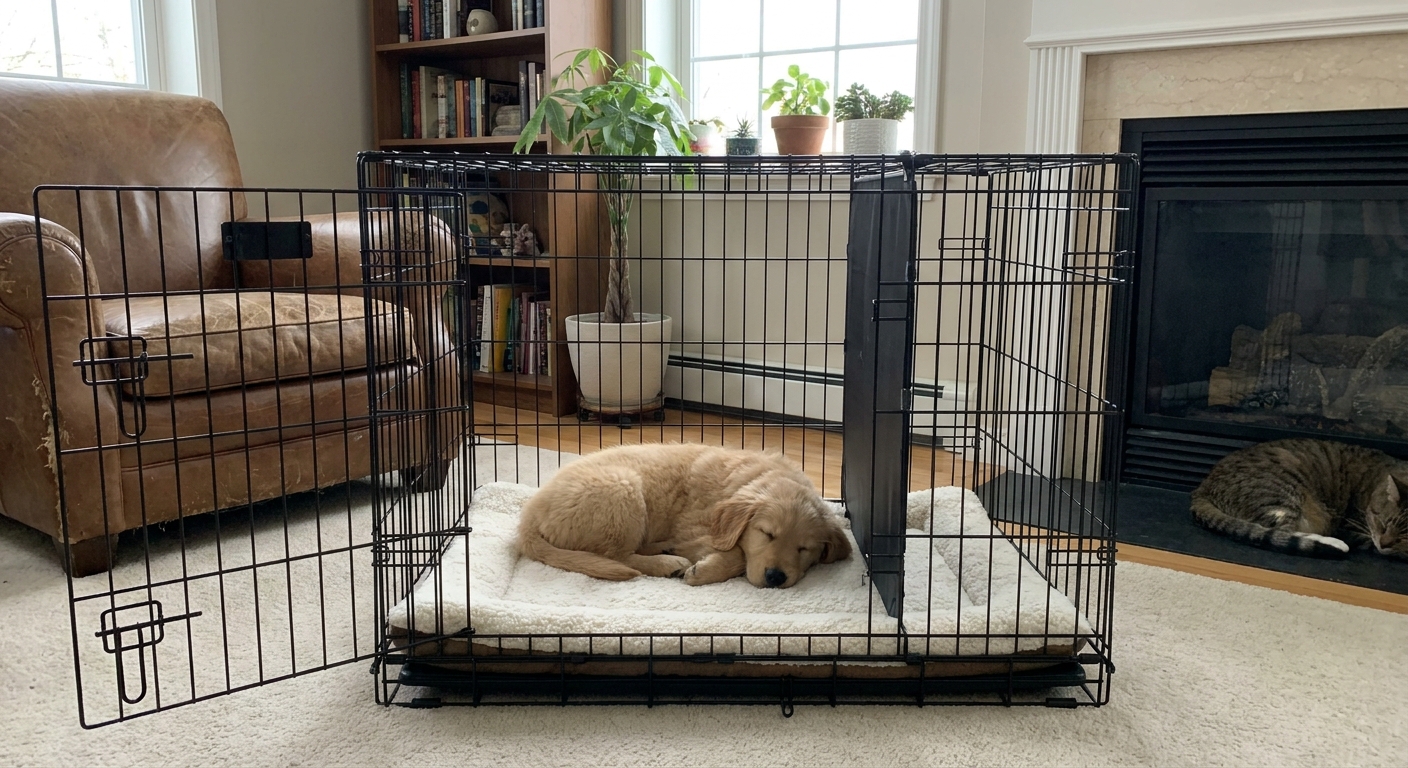
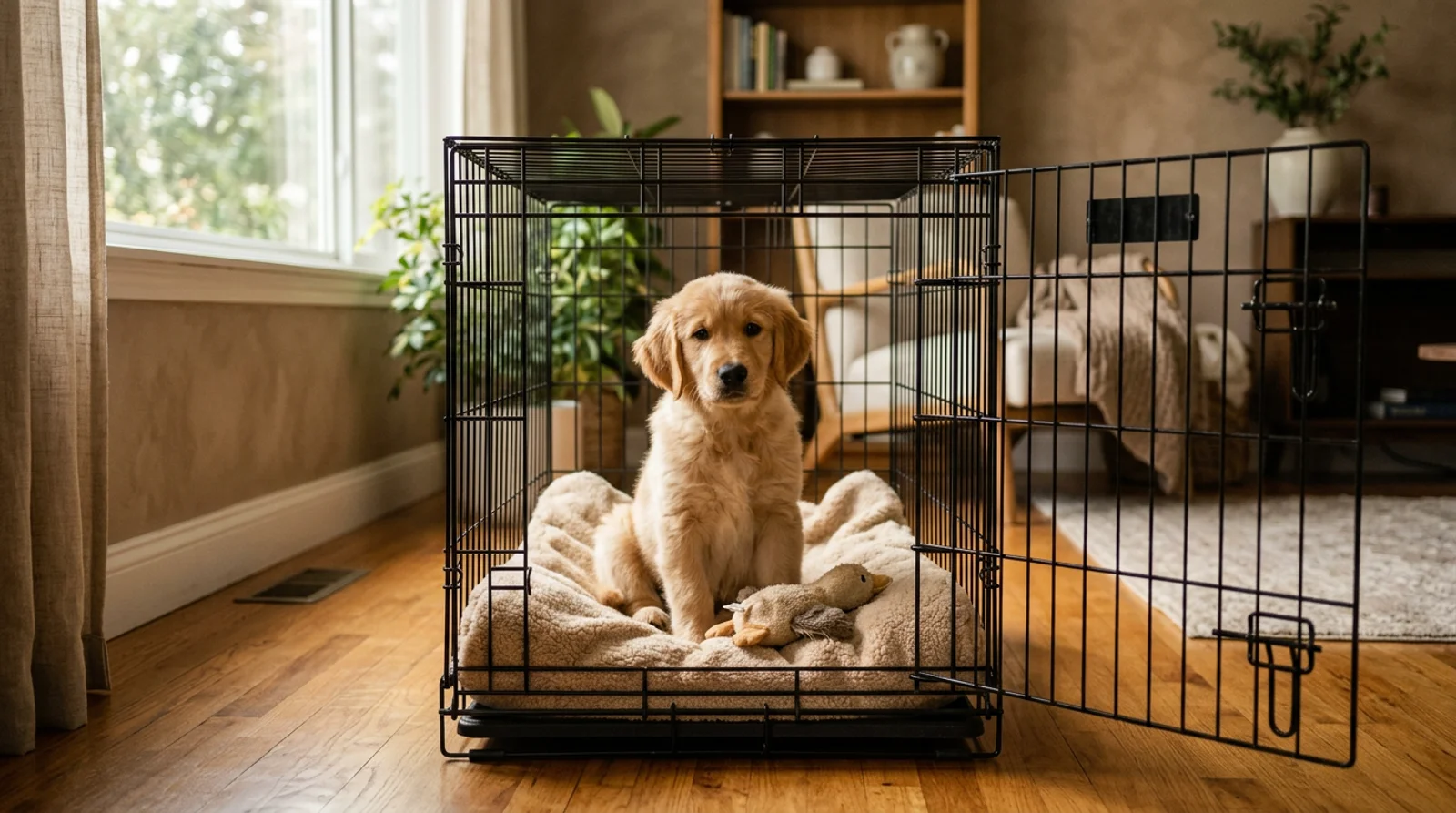
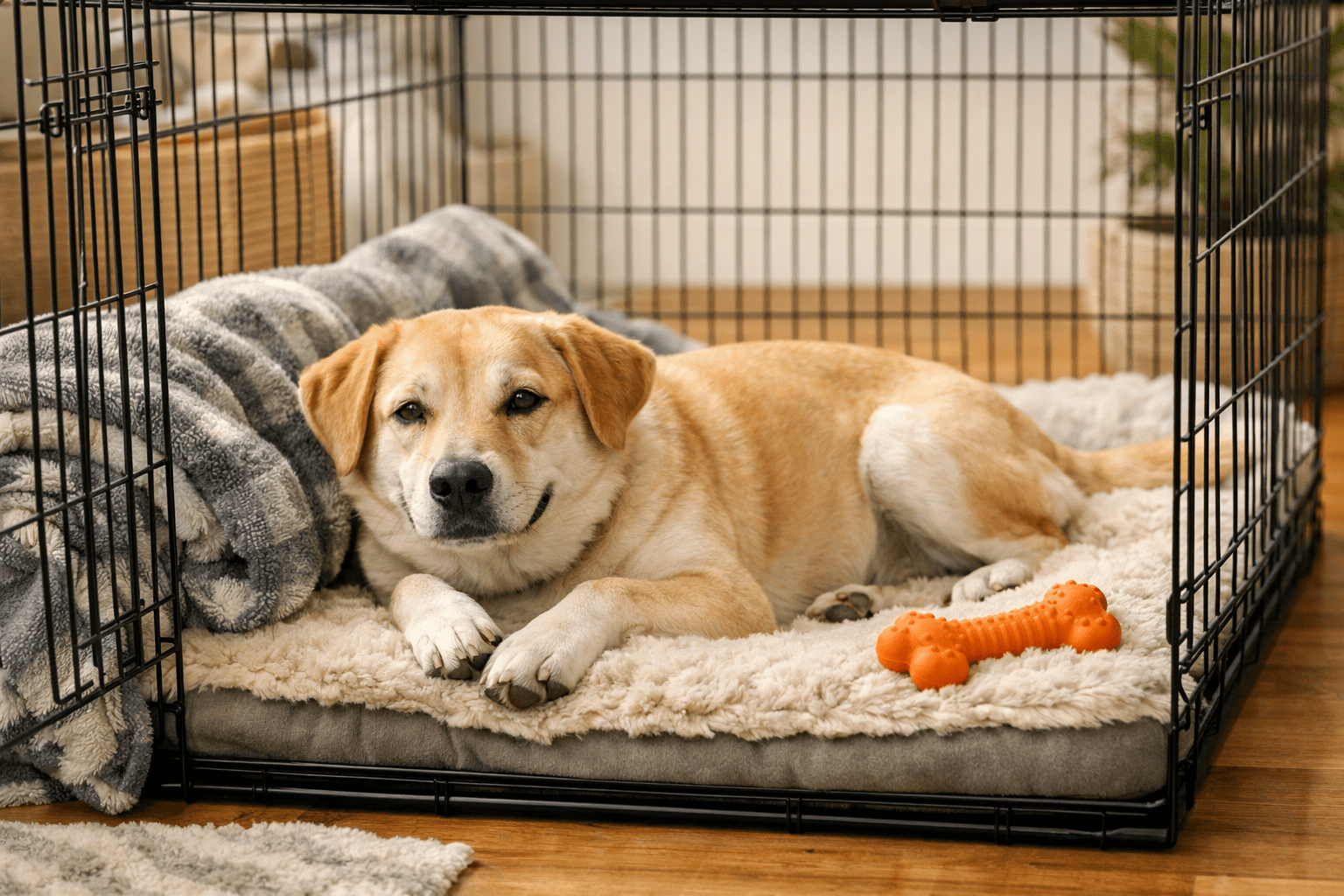
Crate: great for many puppies
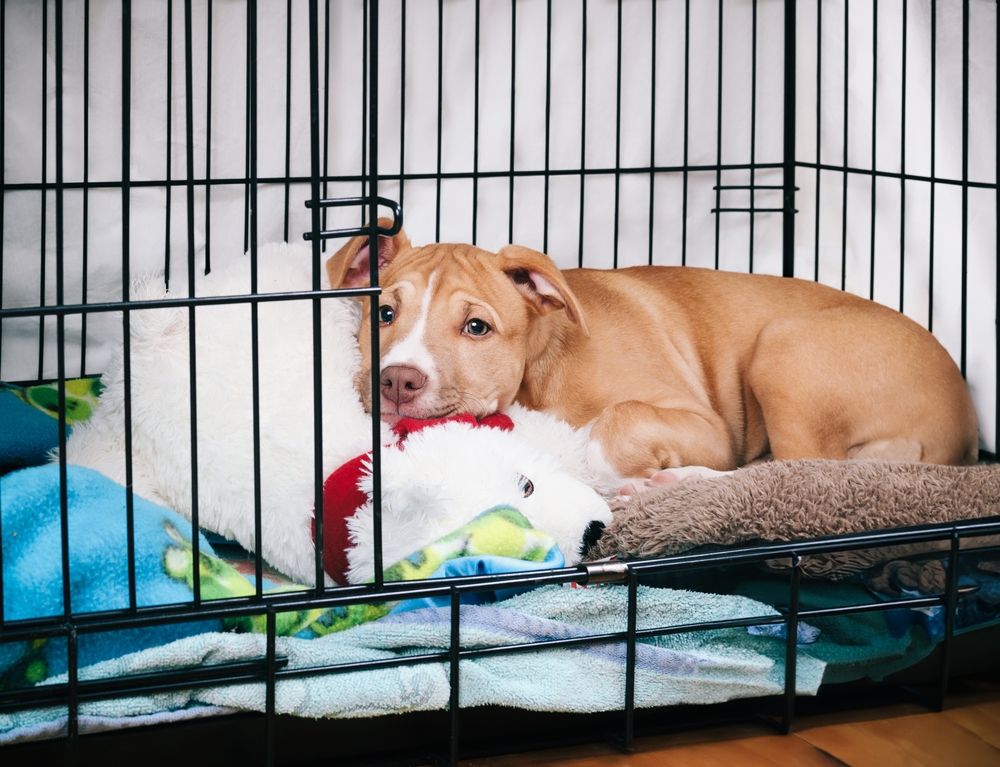
A crate can be a cozy bedroom. But if a puppy panics in a crate, crating can intensify separation distress because the puppy feels both alone and physically unable to move away from the scary feeling.
- Good signs: your puppy chooses to nap in the crate, eats in it, chews calmly, and can settle after mild fussing.
- Red flags: frantic biting at bars, nonstop screaming, heavy drooling, bloody gums, bent crate wires, or trying to escape.
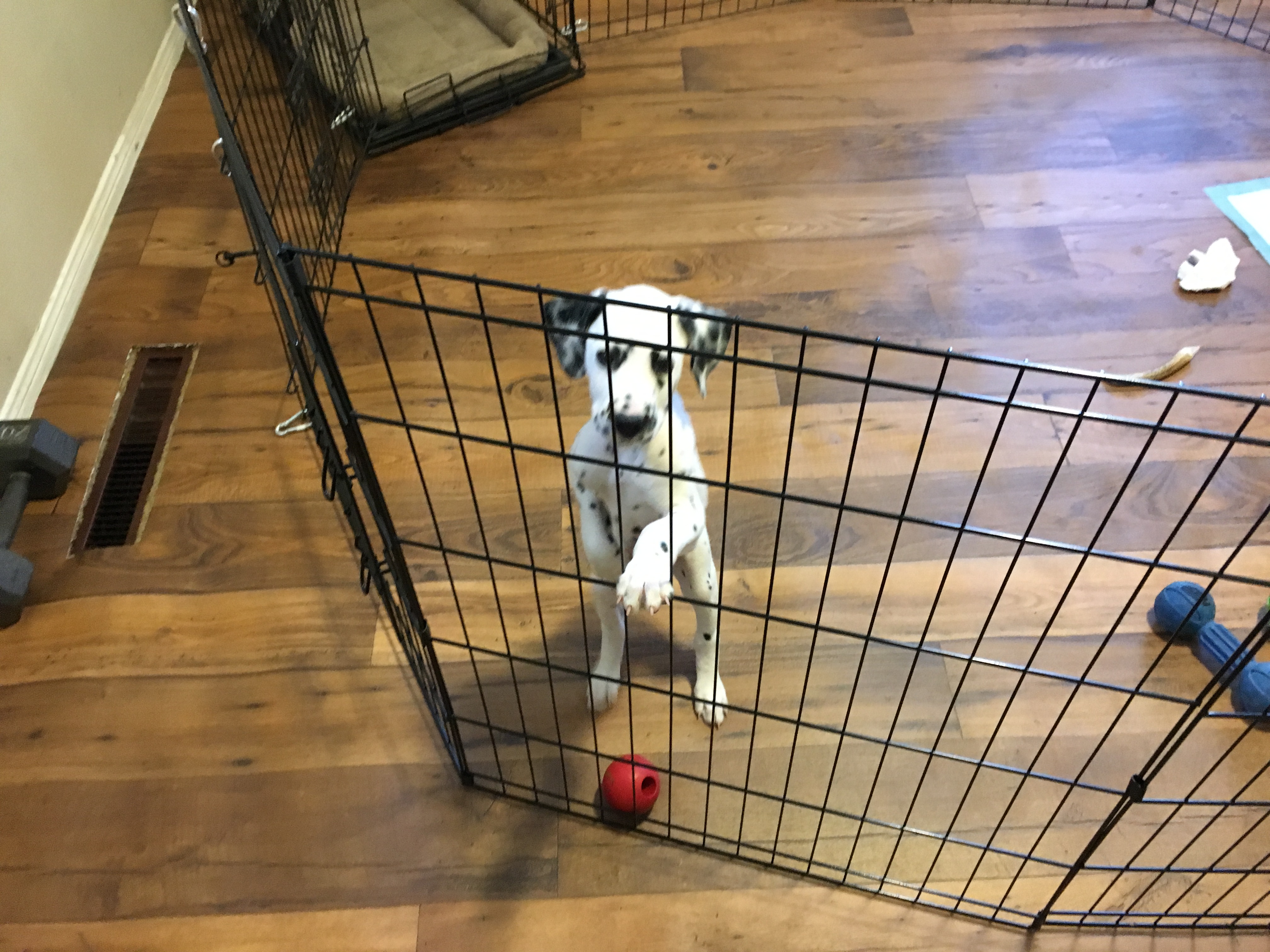
Pen or gated area: the sweet spot for many puppies
An exercise pen with a bed, water, and a couple of safe chews gives many puppies enough room to feel less trapped while still keeping them safe.
Puppy-proof room: best for puppies who hate confinement
If your puppy settles better with more space, use a puppy-proof room (often a kitchen or laundry room) with a baby gate.
- Remove shoes, kids’ toys, cords, and anything chewable at puppy height.
- Use a tough chew, a stuffed food toy, and a bed or mat.
- Consider a white noise machine to soften outdoor sounds.
Quick safety check
- Remove collars and dangling tags for crate and pen time to reduce snag risks.
- Be picky about chews. Avoid very hard chews that can crack teeth, and take away anything that splinters or breaks into big chunks.
- Supervise new items first. If you have not watched your puppy chew it safely, it is not an “alone-time” toy yet.
- Water is case-by-case. Many puppies do fine with a spill-proof bowl. If your puppy plays in water or tips bowls, adjust your setup and ask your vet if you are unsure.
Use food toys the right way
Food toys can be magic, but only if your puppy will actually use them when alone. Many anxious puppies refuse food, which is useful information, not a failure.
Pick high value and puppy-safe projects
- Stuffed rubber toy with kibble mixed with wet food, then frozen
- Snuffle mat sprinkled with part of a meal
- Vet-approved puppy chew (if you are unsure, ask)
If your puppy finishes the food toy and then panics, your duration is too long. Shorten the absence so they succeed.
Make it special
When the same chew appears every day at 8:30, it becomes a leaving cue. That can still be fine, but we want it to predict something good. Use the special chew only for practice sessions and real departures so it keeps its power.
Daily routine tweaks
Separation confidence is built all day long, not just at the door.
Meet needs first: potty, body, brain
A puppy who is bursting with energy or needs to pee is not going to “learn to relax.” Before alone time, aim for:
- A potty break
- 5 to 15 minutes of age-appropriate play or a short sniff walk
- A quick brain game (find it, basic cues, simple puzzle)
Then you offer a chew and quiet time. You are setting your puppy up to feel sleepy, not stranded.
Keep greetings low-key
If your puppy jumps, cries, and spins, it is tempting to scoop them up and apologize. I get it. Calm greetings will not cause separation anxiety, and they will not cure it on their own either, but they can help keep arousal from spiking.
- Come in, put your stuff down, take a breath.
- Wait for a sit or four paws down.
- Then greet and go straight outside for a potty break.
Practice alone with people home
This is the sneaky one that helps the most. Put your puppy in their pen with a chew while you are still in the house. You are teaching them that alone time is normal, not a sign you vanished.
If you have to leave anyway
Real life does not always wait for training. If you must be gone longer than your puppy can handle right now, lean on management so you do not accidentally build the panic pattern.
- Ask a friend, neighbor, or family member to provide a potty break and quiet company.
- Use a pet sitter or reputable daycare for longer days (especially for young puppies).
- If your puppy is not ready for full alone time, choose the least stressful option available, even if it is not your forever plan.
What not to do
- Do not punish whining or barking. Fear does not learn from scolding. It learns from safety and repetition.
- Do not “cry it out” if your puppy is panicking. Mild fussing can resolve. Panic usually escalates and can create a stronger negative association with being alone.
- Do not make departures emotional. Long goodbyes can make the moment feel more important and more upsetting.
- Do not rush crating if the crate triggers distress. You can use a pen or puppy-proof room while you rebuild the crate as a positive place.
- Do not rely on tiring them out to fix it. Exercise helps, but anxiety is not just extra energy.
A realistic timeline
Most puppies need weeks, not days, to feel confident alone. The younger the puppy and the bigger the life change, the more gradual you should go. A common progression looks like this, but your puppy may move faster or much slower.
- Week 1 at home: focus on micro-separations, calm confinement, and neutralizing leaving cues.
- Weeks 2 to 4: build real departures from seconds to minutes, several times per week.
- Months 2 to 4: extend into longer stretches as your puppy matures, while still practicing short easy wins.
If you adopted a rescue puppy who already shows distress, your timeline may be much slower. Slow is still progress.
Troubleshooting
“My puppy cries the second I stand up.”
Stand up and sit down repeatedly throughout the day. Add a treat for staying on the bed or in the pen. Standing up becomes boring.
“My puppy is fine until the food toy is done.”
Your absence is currently longer than their comfort window. Reduce the duration, or increase the challenge of the food toy (freezing, packing tighter, using part of a meal).
“My puppy won’t eat when I leave.”
That often means the situation is too hard right now. Practice with shorter departures or start with barrier work (baby gate) while you stay visible, then fade distance.
“Crate training is going well, but leaving the house is still chaos.”
Separate the skills. Keep building crate comfort when you are home, and build leaving skills with ultra-short departures. Your puppy can love the crate and still be upset when you disappear.
When to get extra help
Reach out to your vet or a trainer with separation-anxiety experience if you see any of the following:
- Self-injury or escape attempts (bloody paws, broken teeth, bent crate wires)
- Extreme drooling, vomiting, or diarrhea linked to being alone
- Nonstop panic vocalizing that does not improve with shorter sessions
- Inability to eat or engage with any calming activity when alone
Separation distress is treatable, but it is easier and kinder when you catch it early.
Quick FAQ
Should I get a second dog to prevent separation anxiety?
Sometimes another dog helps, sometimes it does not, and sometimes you end up with two stressed dogs. It is better to teach the skill of being alone than to assume a buddy will solve it.
Does letting my puppy sleep in my bedroom cause separation anxiety?
Not automatically. Many puppies sleep better near their people, especially early on. The key is still practicing alone time during the day in small, positive steps.
Is it okay to leave the TV or radio on?
It can help mask outside noises. It will not fix separation distress on its own, but as part of a calm setup, it is a reasonable tool.
How long can a young puppy be left alone?
It depends on age, bladder, and comfort. A common rule of thumb for potty capacity is roughly one hour per month of age, but many puppies need breaks more often, and behavior comfort can be shorter than bladder capacity. When in doubt, plan for help, keep absences within your puppy’s comfort window, and ask your vet what is appropriate for your puppy.
My simple plan
If you want one straightforward routine, here it is:
- Two times daily: a few minutes of calm pen or crate time with a chew while you are nearby.
- Most days: a handful of fake leaving cues (keys, shoes, door) followed by staying home and being boring.
- A few times weekly: real departures that start at seconds and build slowly, using a camera if you can.
When in doubt, make it easier. Your puppy is not trying to be dramatic. They are trying to feel safe. You are teaching them that alone is just another normal part of a very good life.