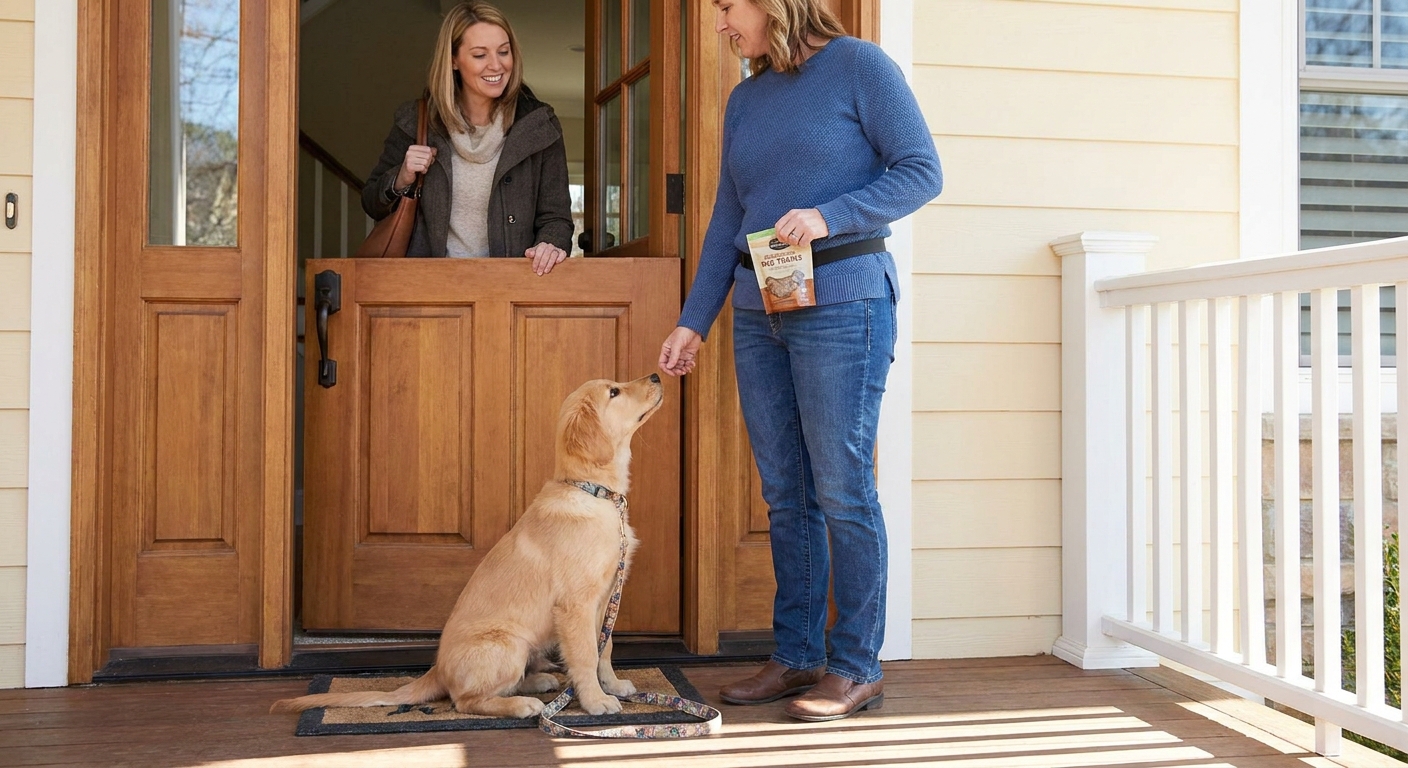
If your puppy turns into a tiny trampoline the second someone steps through the door, you are not alone. Jumping is normal puppy enthusiasm and it works. People laugh, squeal, pet them, talk to them, or even push them away (still attention). Your puppy learns, “Oh wow, jumping makes humans do stuff.”
The goal is not to make your puppy less happy to see people. We just want to give them a different job that gets them what they want: attention. Most families have the best success teaching sit for greetings and setting up the entryway so your puppy can actually succeed.
Why puppies jump (and why it sticks)
Jumping usually comes from one of these very puppy-ish reasons:
- They want to say hi faster. Faces and hands are up high. Puppies go vertical to reach them.
- It has a history of paying off. Even one guest who pets a jumping puppy can keep the habit alive.
- They are overexcited and under-skilled. Big feelings, not enough coping tools yet.
- They are practicing what they rehearse. The front door is basically a daily jumping gym.
So we fix it with two levers: management (prevent jumping practice) and training (teach a clear alternate behavior).
The core rule: jumping never earns attention
This is the part that makes or breaks everything. Your puppy does not need punishment, but they do need clarity.
- If paws are on the floor: attention can happen.
- If paws leave the floor: attention stops.
That means no talking, no touching, and no eye contact when your puppy jumps. Even “Off!” can be exciting. I know it feels rude to ignore your own dog, but for many attention-seeking jumpers, it is one of the most effective ways to remove the paycheck from jumping.
Step-by-step: teach “sit to say hi”
We are going to build a greeting routine that is simple enough for guests to follow and rewarding enough that your puppy actually chooses it.
Step 1: make “sit” a reflex
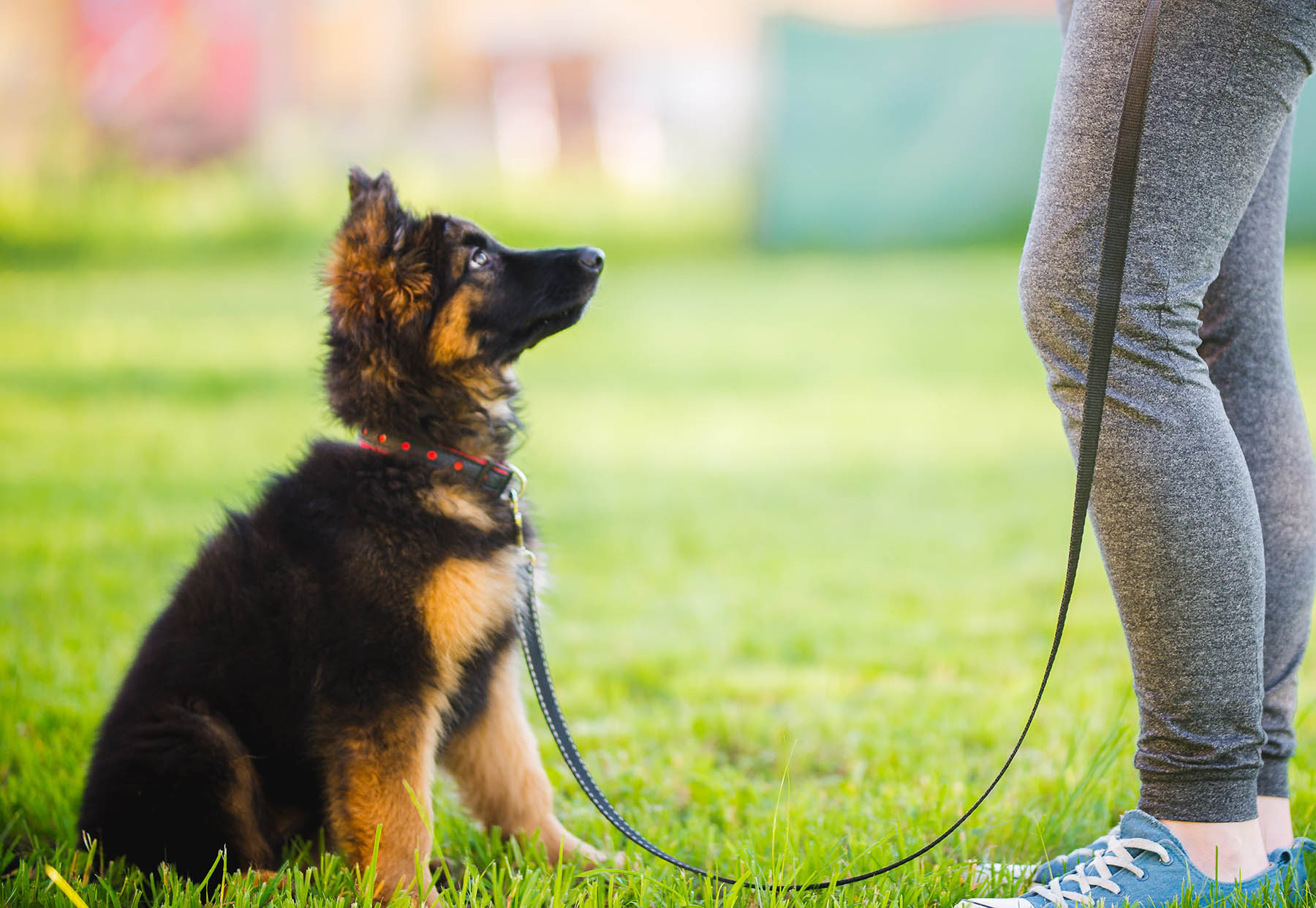
Before you add visitors, your puppy should be able to sit quickly in boring places. Practice 1 to 2 minutes at a time, a few times a day.
- Hold a treat at your puppy’s nose, move it up and back slightly.
- The moment their butt hits the floor, say “Yes” (or click) and give the treat.
- After a few reps, add the word “Sit” right before you lure.
Step 2: add the greeting picture
Put your puppy on leash. Have a family member act as the “guest.” Start easy: the person is calm, no baby talk, no looming, no fast hands.
- Approach the person.
- Ask for sit far enough away that your puppy can succeed.
- If your puppy sits, the person calmly pets on the chest or side of the neck, and you feed a treat. Many dogs find this easier than a hand reaching over their head.
- If your puppy jumps, the person turns their body away and removes hands. You gently guide your puppy back a step and try again.
Think of it as a little loop: sit makes people come closer, jumping makes people go boring.
Step 3: build duration (the secret sauce)
Many puppies can sit for one second. The hard part is staying seated while the human is exciting.
- Reward quickly at first: treat after one second of sitting.
- Then stretch it: 2 seconds, 3 seconds, 5 seconds.
- If your puppy pops up, the guest pauses and turns away. Reset, then reward a shorter sit again.
Step 4: practice with real-life movement
Now have your “guest” do the things that usually trigger jumping:
- Walk in with a bag
- Take a step back like they are leaving
- Bend slightly to pet
- Talk in a happy voice
Reward your puppy for sitting through these mini temptations. This is how you train for the actual door chaos.
Set your puppy up to win
The entryway is where manners fall apart because it is unpredictable and exciting. Management keeps your puppy from rehearsing launching at guests while you train.
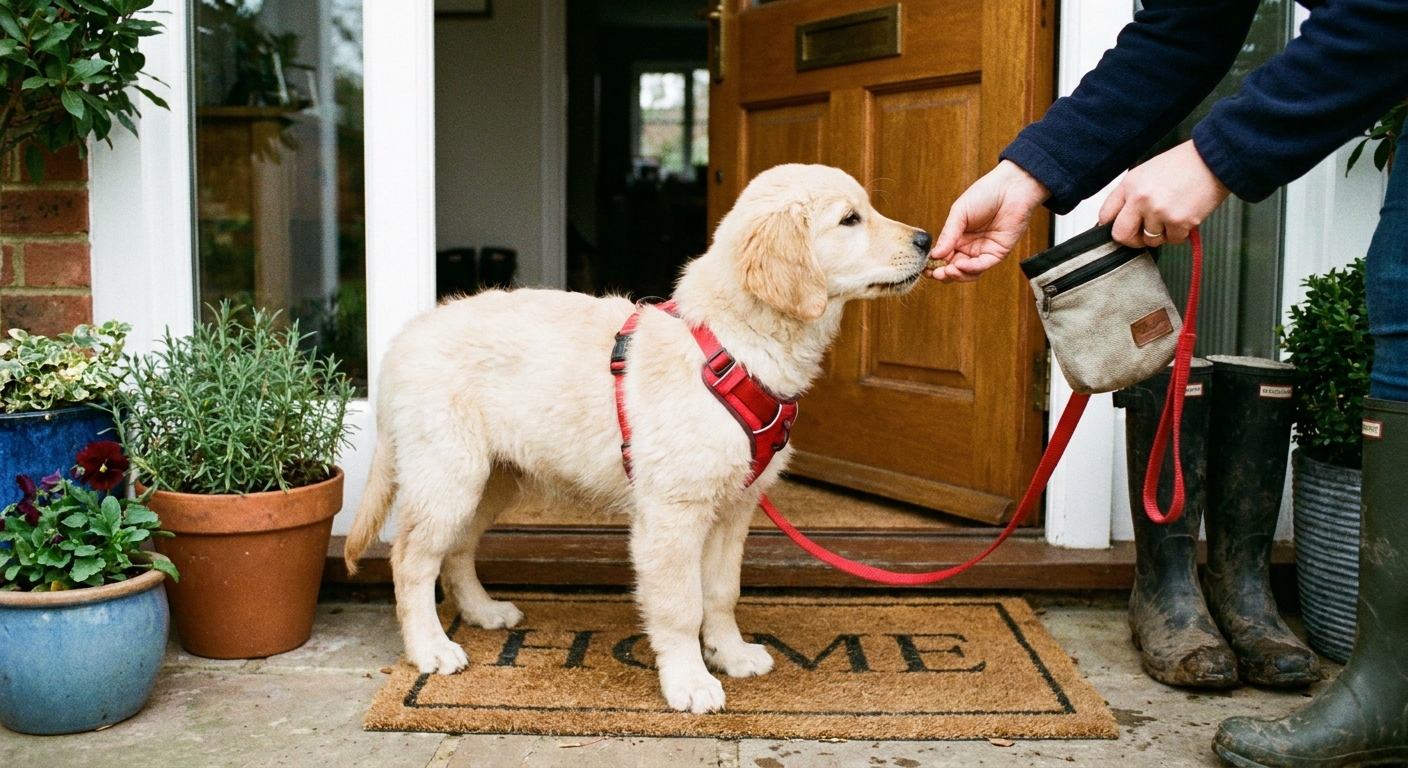
Use one of these setups
- Leash on before opening the door. Simple and effective. For safety, clip the leash to a harness (not a collar), keep slack, and step on the leash only enough to limit jumping. The goal is to prevent a launch, not to create a sudden stop or neck pressure.
- Baby gate or exercise pen. Great for puppies who get mouthy when excited. Guests enter, puppy settles, then you do a calm greeting.
- Crate with a chew. Best for very high arousal puppies, or if you have multiple guests arriving at once.
Do a “door drill” when nobody is visiting
Training the door only when guests arrive is like studying only during the exam.
- Put treats in a jar by the door.
- Touch the handle. If your puppy keeps four paws down, mark and treat.
- Open the door one inch, then close it. Mark and treat for calm.
- Gradually open wider, step out and in, ring the doorbell sound softly if you can.
Keep sessions short. Stop before your puppy spirals into full tornado mode.
What to tell guests
Your puppy is not the only one in training here. Guests often accidentally reward jumping because they feel bad ignoring a happy dog. Give them a simple plan before they walk in.
Guest script
- Please ignore my puppy at first.
- If they jump, turn your body away and keep your hands to yourself.
- When they sit (or keep four paws down), you can calmly pet their chest.
Keep it light. I usually say, “He is in his ‘polite hello’ era and he is terrible at it.” People laugh and cooperate.
Low-pressure option: the treat toss
If you have excitable greeters, guests who forget the rules, or people who are nervous around puppies, use this instead: have your guest toss a few treats on the floor as they enter. Sniffing and eating keeps four paws down and gives your puppy something to do while the door chaos passes.
Fixes for common scenarios
“My puppy sits, then immediately jumps anyway.”
That means the sit is not strong enough yet, or the greeting is too intense. Reward the sit faster, ask guests to be calmer, and build duration slowly. Also try feeding a few treats in a row while your puppy remains seated, like: treat, treat, treat, then release.
“My puppy jumps more when people ignore them.”
This is a classic extinction burst. When the old trick stops working, puppies often try harder before they give up. Stay consistent and manage for safety during the burst (leash, gate, distance). If you cave and pet them mid-burst, you teach them to jump longer next time.
“My puppy is huge. Jumping is not cute anymore.”
Use management while you train. Leash, gate, or crate for every arrival. You can also teach a go to mat cue (bed equals treats) so your dog has a safe station away from the door until they can greet politely.
“My puppy nips when guests come in.”
Nipping and jumping are often the same problem: overexcitement. Skip the greeting entirely at first. Put puppy behind a gate with a stuffed food toy, let guests enter, and only attempt a greeting once your puppy is calmer. If nipping is frequent or intense, get a qualified positive reinforcement trainer involved, especially with kids in the home.
“My puppy jumps on kids or elderly guests.”
Do not practice on people who can get knocked over. Use a gate or crate and reward calm behavior from a distance. Safety first, always. Your puppy can learn manners without physically greeting everyone.
Bonus skill: “go to mat”
Sitting is great. A mat behavior is even better when you want your puppy out of the doorway.
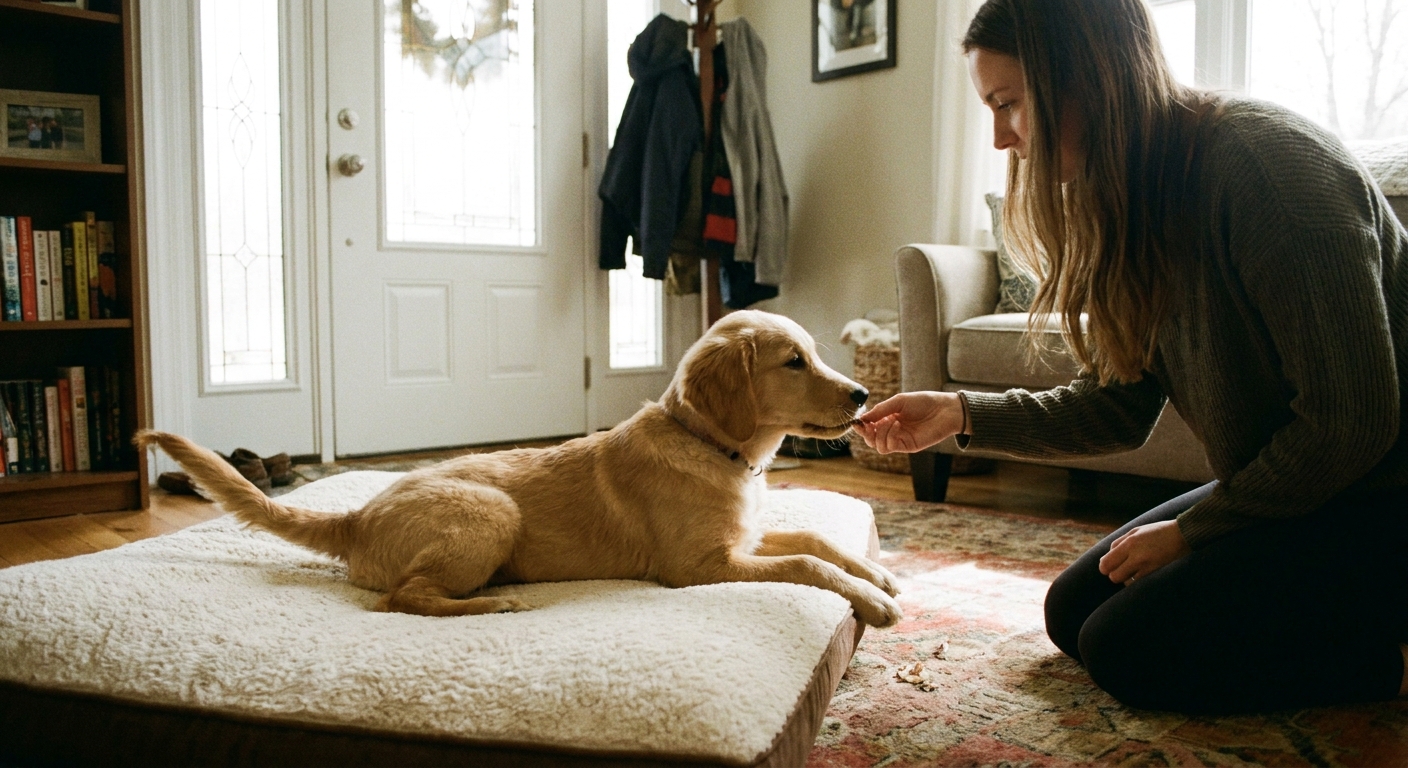
How to start
- Place a mat or dog bed a few feet from the door.
- When your puppy steps on it, mark “Yes” and toss a treat onto the mat.
- Repeat until your puppy starts seeking the mat on purpose.
- Add the cue “Mat” right before they step onto it.
- Gradually reward for sitting or lying down on the mat, then for staying longer.
When guests arrive, cue “Mat,” reward, then open the door. If your puppy gets up, the door closes and you try again. The door becomes part of the training game.
How long will it take?
Many families see improvement within 1 to 2 weeks of consistent practice, with more reliable greetings often taking 4 to 8 weeks or longer. Age, breed, excitement level, visitor frequency, and how long jumping has been rewarded all make a difference.
The fastest progress usually comes from this combo:
- Daily 2-minute “sit to say hi” reps
- Door drills when nobody is visiting
- Management every single time the door opens
Mistakes that keep jumping alive
- Inconsistent rules. Some people allow jumping, others do not. Your puppy will keep trying. Get everyone on the same plan, including frequent visitors. If someone cannot follow it, use a gate or treat toss greeting instead.
- Pushing the puppy down. Many puppies think this is play. Some get more wound up.
- Asking for “down” when you mean “off.” “Down” usually means lie down, not stop jumping. Use “Off” if you want a cue, but still teach what to do instead.
- Waiting until guests arrive to practice. Train when you are not stressed and your puppy is not exploding.
- Letting greetings go on too long. Keep hellos short. A few seconds of calm petting is enough, then guide your puppy away with a treat scatter or a toy.
FAQ
Should I knee my puppy in the chest to stop jumping?
No. It can hurt your puppy and can make some dogs more frantic or fearful. It also does not teach the behavior you want. Use management plus rewarding four paws on the floor, and teach sit for greetings.
What if my guest will not follow the rules?
Then your puppy does not get to greet them. Use a gate, crate, or keep your puppy leashed and at a distance. Protect your training. You can be polite to your guests and still be firm about your dog’s manners.
Can I use treats forever?
You will not need a treat for every single greeting forever, but treats help you build the habit quickly. Once your puppy is reliable, switch to rewarding randomly and using real-life rewards too, like petting, a tossed toy, or permission to say hi.
My puppy jumps most when I come home. Same training?
Yes, and it is often easier to practice because you can rehearse it daily. Walk in calmly, turn away if your puppy jumps, and only greet when they sit or keep four paws down. Keep arrivals boring for a week and you will be amazed.
What if my puppy seems scared, not excited?
If greetings come with stiff body language, tucked tail, growling, repeated barking, lunging, hiding, or snapping, treat this as a fear or reactivity issue, not just “rude jumping.” Use distance and barriers, avoid forcing greetings, and consider working with a qualified positive reinforcement trainer to build safer, calmer associations.
A calm hello is still a happy hello
Jumping is not your puppy being “bad.” It is your puppy being excited and accidentally well-trained by the world. With a consistent rule, a simple alternate behavior like sit, and a little front-door management, your puppy can learn that the fastest way to get love is to keep their paws on the floor. Your guests keep their outfits intact, and your puppy still gets to be the life of the party, just in a more polite package.